


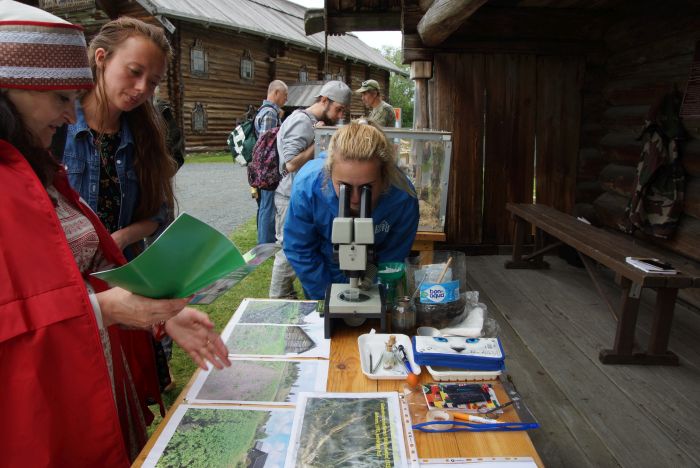
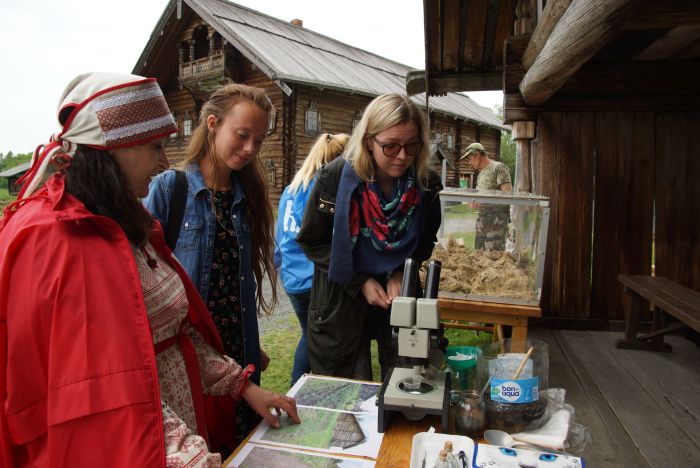
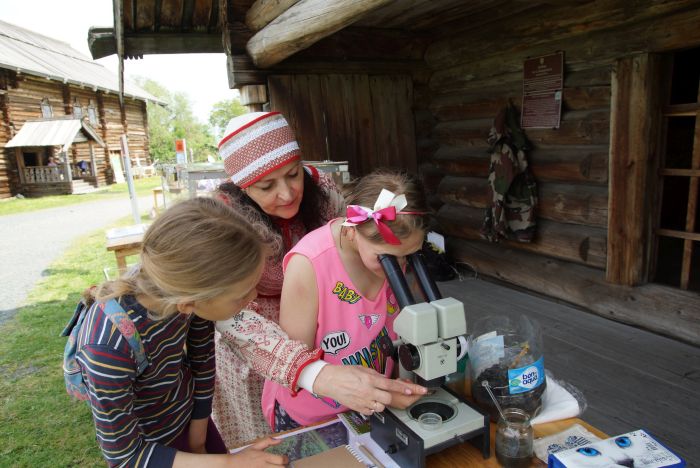
The educational spot “Hard to see, yet very dangerous” on Kizhi Island offered information on an invasive species – potato cyst nematode Globodera rostochiensis Woll., a hazardous potato pest subject to both exterior and interior quarantine.
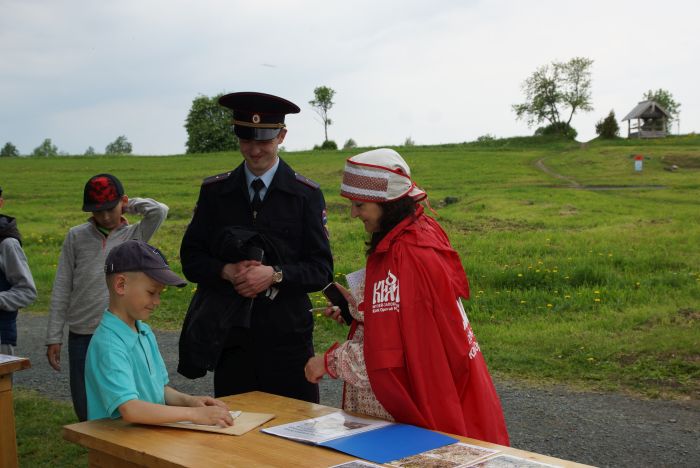
Locals and tourists could take a look at the parasitic roundworm at the main stage of its life cycle – cyst (through a binocular microscope) and were told how they can themselves determine how much the soil is infected by nematode cysts. Visitors of this spot were told about the domestically applicable ways to control the parasite, and information about this invasive species was disseminated (flyers). Brief info about the DIAS project was handed over to the Kizhi Open Air Museum and Vodlozersky National Park. After giving a master class with basic information on potato cyst nematode, soil samples from potato fields were collected from residents of nearby villages for accurate determinations of the infection and working out of recommendations for controlling pest numbers. A mini experiment was established in one private plot to develop environment-friendly methods for controlling potato cyst nematode populations.
Karelia Cross-border Cooperation Programme is financed by the European Union, the Russian Federation and the Republic of Finland.
International
News

June 13, 2019
On June 5, 2019 KarRC RAS staff participating the project “DIAS - Collaborative Data and Information Exchange Network for Managing Invasive Alien Species ” under ENI Karelia CBC Programme took part in the EcoKizhi environmental education event organized by the Kizhi Open Air Museum in the framework of the World Environment Day.
See also:

March 30, 2026
Young CIS scientists networked on common water problems at a school and workshop organized by the KarRC RAS
The international school and workshop “Under the Pressure of Global Climate Change: a Youth Network for Water Ecosystem Research” in Petrozavodsk has come to an end. During four days, young researchers from Russia, Belarus, Kyrgyzstan, Kazakhstan, Armenia, Uzbekistan, and Tajikistan listened to lectures and mastered scientific techniques in practice, under the guidance of seasoned experts. In conclusion, the participants agreed to maintain the network and keep looking for opportunities to jointly study common environmental problems.
The international school and workshop “Under the Pressure of Global Climate Change: a Youth Network for Water Ecosystem Research” in Petrozavodsk has come to an end. During four days, young researchers from Russia, Belarus, Kyrgyzstan, Kazakhstan, Armenia, Uzbekistan, and Tajikistan listened to lectures and mastered scientific techniques in practice, under the guidance of seasoned experts. In conclusion, the participants agreed to maintain the network and keep looking for opportunities to jointly study common environmental problems.

March 27, 2026
RAS Corr. Fellow Olga Bakhmet: Arctic biodiversity conservation is impossible without science as its foundation
The International Forum "Polar Bear Universe", organized by the Ministry of Natural Resources of Russia and the Government of the Chukotka Autonomous Okrug, is taking place in St. Petersburg. At the forum’s Bio-ecological Arctic Cluster, KarRC RAS leader, RAS Corr. Fellow Olga Bakhmet spoke about the scientific foundations for conserving Arctic biodiversity and presented the expertise of Karelian scientists in this field.
The International Forum "Polar Bear Universe", organized by the Ministry of Natural Resources of Russia and the Government of the Chukotka Autonomous Okrug, is taking place in St. Petersburg. At the forum’s Bio-ecological Arctic Cluster, KarRC RAS leader, RAS Corr. Fellow Olga Bakhmet spoke about the scientific foundations for conserving Arctic biodiversity and presented the expertise of Karelian scientists in this field.

March 26, 2026
Olga Bakhmet presented KarRC’s proposals for the federal Clean Ladoga project in St. Petersburg
Experts of the Karelian Research Centre RAS have prepared proposals for the federal project Clean Ladoga. The Centre’s CEO, Olga Bakhmet, presented them at a joint meeting of the Environmental Council under the Governor of St. Petersburg and the Public Environmental Council under the Governor of the Leningrad Region. The main point of her presentation was that the integrated program for the environmental rehabilitation of Lake Ladoga must encompass also the water bodies located throughout the lake’s catchment area.
Experts of the Karelian Research Centre RAS have prepared proposals for the federal project Clean Ladoga. The Centre’s CEO, Olga Bakhmet, presented them at a joint meeting of the Environmental Council under the Governor of St. Petersburg and the Public Environmental Council under the Governor of the Leningrad Region. The main point of her presentation was that the integrated program for the environmental rehabilitation of Lake Ladoga must encompass also the water bodies located throughout the lake’s catchment area.

March 24, 2026
A youth school and workshop on aquatic ecosystem studies gathers learners and lecturers from CIS countries at the KarRC RAS
The international school and workshop "Under the Pressure of Global Climate Change: a Youth Network for Aquatic Ecosystem Research" was launched in Petrozavodsk on March 24. Over four days, young researchers from Russia, Belarus, Kyrgyzstan, Kazakhstan, Armenia, Uzbekistan, and Tajikistan will engage in theoretical and practical training under the guidance of experts from the KarRC RAS and researchers from CIS countries, India, and China.
The international school and workshop "Under the Pressure of Global Climate Change: a Youth Network for Aquatic Ecosystem Research" was launched in Petrozavodsk on March 24. Over four days, young researchers from Russia, Belarus, Kyrgyzstan, Kazakhstan, Armenia, Uzbekistan, and Tajikistan will engage in theoretical and practical training under the guidance of experts from the KarRC RAS and researchers from CIS countries, India, and China.

March 16, 2026
Karelian entomologist, Andrei Humala, discovered six new species of parasitoid wasps last year
In 2025, entomologist from Karelia, Andrei Humala, described four new parasitoid wasp species from Africa. They all belong to a genus relatively rare in that region, Eusterinx. One more finding was made in each of samples from Mexico and Russian Far East. The scientist has specialized in the study of parasitoid wasps for over 30 years, during which time he has described 3 genera and 149 species new to science.
In 2025, entomologist from Karelia, Andrei Humala, described four new parasitoid wasp species from Africa. They all belong to a genus relatively rare in that region, Eusterinx. One more finding was made in each of samples from Mexico and Russian Far East. The scientist has specialized in the study of parasitoid wasps for over 30 years, during which time he has described 3 genera and 149 species new to science.