


During the plenary session of the conference “BRICS Countries: development strategies and cooperation mechanisms in a changing world”, its participants discussed a wide range of questions related to politics, health care, and environment. Leading Russian and foreign experts, representatives of relevant ministries and agencies, business, political parties and non-governmental organizations shared their own visions of the key problems of development, interactions and cooperation of alliance member states and proposed concrete recommendations on handling them.
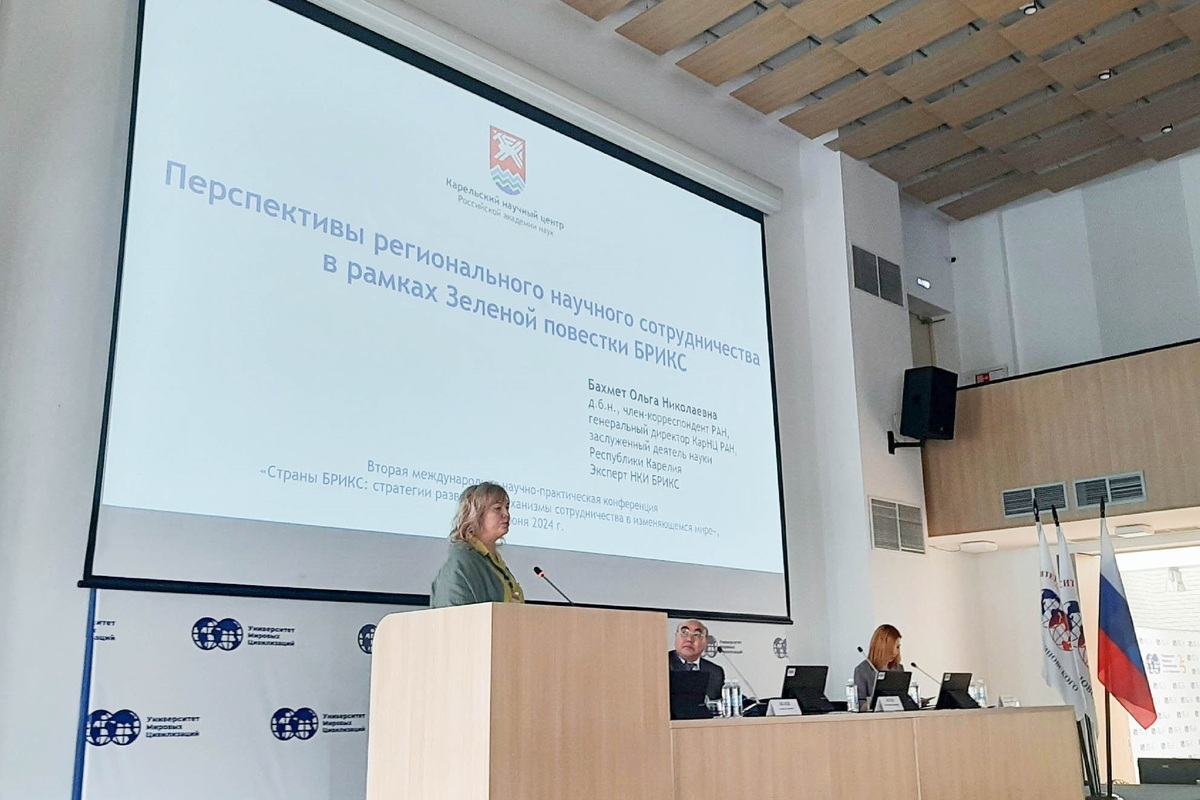
The spheres and prospects of scientific cooperation within the BRICS Green Agenda were presented by KarRC RAS Director General. In her talk, Olga Bakhmet emphasized the need for broader networking with regional science.
— Scientists at the Karelian Research Center RAS conduct basic research in versatile areas. The significance of our results is confirmed by publications in such reputable scientific journals as Science and Nature. Researchers also pay much attention to applied science, coming up with developments in the spheres of biotechnology, mineral raw materials applications, economics, and tourism. At the same time, our scientists are engaged in popularization of scientific knowledge, telling the public about the results of their work. International projects with BRICS countries are important for us, for example, we continue joint activities with geologists from India, China and South Africa on the study of ancient Archean rocks, with mathematicians from India and China on problems and tasks of mathematical optimization and stochastic modeling, with the Chinese Academy of Sciences in the field of limnology and environmental toxicology. We would like to further expand and deepen these ties. In addition, there is a number of interesting project initiatives that have not yet received funding and are waiting to be implemented. It is therefore important to discuss the issues of financing network cooperation with regions at the upcoming BRICS summit in Kazan in October, — told Olga Bakhmet.
KarRC RAS leader also advertised the second regional conference “Regional cooperation within BRICS: modern environmental and nature management issues”, which will take place in Petrozavodsk on September 18-20. The conference themes include global and regional climate change, monitoring of carbon balance, sustainable nature management solutions from BRICS countries, regional experience in industrial ecology and green economy, nature protection and biodiversity conservation, and many others.
Be reminded that the first regional BRICS conference took place in Petrozavodsk on September 14-16, 2023. Its main topics were the green transition and raising public awareness of the risks and threats of climate change.
International
News
June 27, 2024
The Second International Conference “BRICS Countries: development strategies and cooperation mechanisms in a changing world” was held in Moscow. KarRC RAS Director General Olga Bakhmet delivered a plenary talk about the main spheres and prospects on scientific cooperation within the BRICS Green Agenda. The Centre’s leader also advertised the regional BRICS Conference to take place in Petrozavodsk in September.
See also:

March 30, 2026
Young CIS scientists networked on common water problems at a school and workshop organized by the KarRC RAS
The international school and workshop “Under the Pressure of Global Climate Change: a Youth Network for Water Ecosystem Research” in Petrozavodsk has come to an end. During four days, young researchers from Russia, Belarus, Kyrgyzstan, Kazakhstan, Armenia, Uzbekistan, and Tajikistan listened to lectures and mastered scientific techniques in practice, under the guidance of seasoned experts. In conclusion, the participants agreed to maintain the network and keep looking for opportunities to jointly study common environmental problems.
The international school and workshop “Under the Pressure of Global Climate Change: a Youth Network for Water Ecosystem Research” in Petrozavodsk has come to an end. During four days, young researchers from Russia, Belarus, Kyrgyzstan, Kazakhstan, Armenia, Uzbekistan, and Tajikistan listened to lectures and mastered scientific techniques in practice, under the guidance of seasoned experts. In conclusion, the participants agreed to maintain the network and keep looking for opportunities to jointly study common environmental problems.

March 27, 2026
RAS Corr. Fellow Olga Bakhmet: Arctic biodiversity conservation is impossible without science as its foundation
The International Forum "Polar Bear Universe", organized by the Ministry of Natural Resources of Russia and the Government of the Chukotka Autonomous Okrug, is taking place in St. Petersburg. At the forum’s Bio-ecological Arctic Cluster, KarRC RAS leader, RAS Corr. Fellow Olga Bakhmet spoke about the scientific foundations for conserving Arctic biodiversity and presented the expertise of Karelian scientists in this field.
The International Forum "Polar Bear Universe", organized by the Ministry of Natural Resources of Russia and the Government of the Chukotka Autonomous Okrug, is taking place in St. Petersburg. At the forum’s Bio-ecological Arctic Cluster, KarRC RAS leader, RAS Corr. Fellow Olga Bakhmet spoke about the scientific foundations for conserving Arctic biodiversity and presented the expertise of Karelian scientists in this field.

March 26, 2026
Olga Bakhmet presented KarRC’s proposals for the federal Clean Ladoga project in St. Petersburg
Experts of the Karelian Research Centre RAS have prepared proposals for the federal project Clean Ladoga. The Centre’s CEO, Olga Bakhmet, presented them at a joint meeting of the Environmental Council under the Governor of St. Petersburg and the Public Environmental Council under the Governor of the Leningrad Region. The main point of her presentation was that the integrated program for the environmental rehabilitation of Lake Ladoga must encompass also the water bodies located throughout the lake’s catchment area.
Experts of the Karelian Research Centre RAS have prepared proposals for the federal project Clean Ladoga. The Centre’s CEO, Olga Bakhmet, presented them at a joint meeting of the Environmental Council under the Governor of St. Petersburg and the Public Environmental Council under the Governor of the Leningrad Region. The main point of her presentation was that the integrated program for the environmental rehabilitation of Lake Ladoga must encompass also the water bodies located throughout the lake’s catchment area.

March 24, 2026
A youth school and workshop on aquatic ecosystem studies gathers learners and lecturers from CIS countries at the KarRC RAS
The international school and workshop "Under the Pressure of Global Climate Change: a Youth Network for Aquatic Ecosystem Research" was launched in Petrozavodsk on March 24. Over four days, young researchers from Russia, Belarus, Kyrgyzstan, Kazakhstan, Armenia, Uzbekistan, and Tajikistan will engage in theoretical and practical training under the guidance of experts from the KarRC RAS and researchers from CIS countries, India, and China.
The international school and workshop "Under the Pressure of Global Climate Change: a Youth Network for Aquatic Ecosystem Research" was launched in Petrozavodsk on March 24. Over four days, young researchers from Russia, Belarus, Kyrgyzstan, Kazakhstan, Armenia, Uzbekistan, and Tajikistan will engage in theoretical and practical training under the guidance of experts from the KarRC RAS and researchers from CIS countries, India, and China.

March 16, 2026
Karelian entomologist, Andrei Humala, discovered six new species of parasitoid wasps last year
In 2025, entomologist from Karelia, Andrei Humala, described four new parasitoid wasp species from Africa. They all belong to a genus relatively rare in that region, Eusterinx. One more finding was made in each of samples from Mexico and Russian Far East. The scientist has specialized in the study of parasitoid wasps for over 30 years, during which time he has described 3 genera and 149 species new to science.
In 2025, entomologist from Karelia, Andrei Humala, described four new parasitoid wasp species from Africa. They all belong to a genus relatively rare in that region, Eusterinx. One more finding was made in each of samples from Mexico and Russian Far East. The scientist has specialized in the study of parasitoid wasps for over 30 years, during which time he has described 3 genera and 149 species new to science.