


On September 25, Olga Bakhmet, Corr. Academician, KarRC RAS Acting Director General, gave a talk during the forum session. The Director presented innovations and applied developments of the Karelian Research Center RAS. According to Olga Bakhmet, Karelian scientists have registered more than 30 patents of inventions and utility models in the field of biotechnology, environmental expert assessment, mining and chemical industries, new materials.
To wit, in the biotechnology field, scientists are engaged in the cultivation of commercially valuable agricultural crops and forest woody plants. The Forest Research Institute KarRC RAS has developed a technology for clonal micropropagation of curly birch and created a unique collection of its clones. The planting stock produced at KarRC RAS is used to create curly birch plantations both for urban landscaping and as crops. Techniques developed at the Institute of Biology can be applied in the fish farming industry. Scientists have designed artificial in-stream egg incubators for restoring populations of salmonid fishes. Biochemists have found a way to reduce the demand for antibiotics in trout farming by using a natural supplement, dihydroquercetin.
Karelian researchers monitor the state of terrestrial and aquatic ecosystems based on a multidisciplinary approach. It includes field and laboratory research methods, as well as Earth remote sensing, computer modeling and other methods.
Olga Bakhmet also told that KarRC RAS is a member of the TIRM Carbon consortium and an active participant of the work to create the Russian national system for climate-active greenhouse gas monitoring. Scientists study carbon pools and fluxes in forest, wetland and aquatic ecosystems and in agricultural landscapes. The Northern Water Problems Institute has designed devices for determining organic carbon in water and for measuring the temperature profile at the water-bottom interface. The Department for Interdisciplinary Research has developed natural carbon gas analyzers. The devices measure soil carbon stocks and its release into the atmosphere.
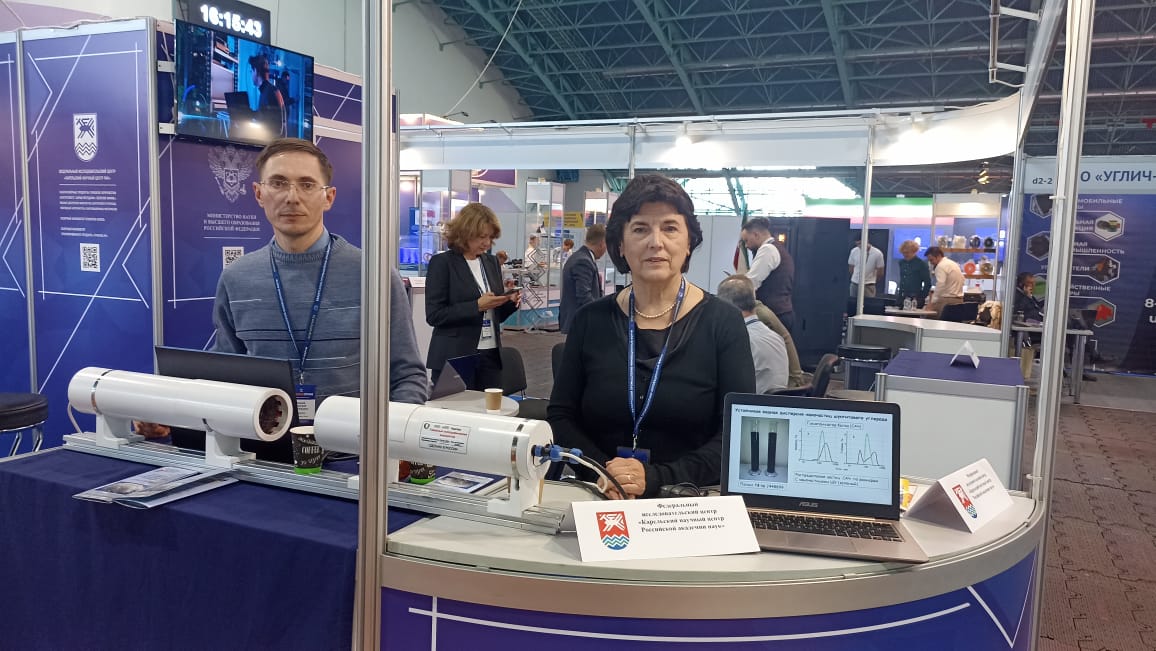
Natalia Rozhkova, Head of the Laboratory for Nanomaterial Physicochemical Studies of the Institute of Geology KarRC RAS, Sergey Rozhkov, Senior Researcher at IG KarRC RAS, and Dmitry Yekimov, Senior Researcher at the Department for Interdisciplinary Research KarRC RAS, are presenting their developments in Belarus in person. They contribute to the Russian Ministry of Science and Higher Education's stand at TechInnoProm 2024, which has gathered the projects and developments of leading universities and RAS institutes. The main theme of the exhibition in 2024 is “Industrial production in modern conditions: import substitution, quality, subcontracting”.
Dmitry Yekimov presented optical devices - pelletized product laser analyzer GRANULA-M1 and droplet size laser analyzer. The former is designed for automatic control of the particle size distribution of pelletized products, such as mineral fertilizers, in industrial settings. The latter is designed to measure the size distribution of particles or liquid droplets. It can be used in spraying systems and nozzles at the design, manufacturing and operation stages in various industries.

Head of Laboratory for Nanomaterial Physicochemical Studies, Institute of Geology KarRC RAS, Natalya Rozhkova at TechInnoProm exhibition
Researchers from the Institute of Geology KarRC RAS demonstrated aqueous dispersions of shungite carbon nanoparticles and a hybrid composite filler. The dispersion can be used in the manufacturing of nanomodified composite materials, in biotechnology and photonics. The scientists have also developed and patented a method for producing a multifunctional hybrid filler from natural shungite raw material for antifriction, heat-resistant and chemically resistant composite materials. Each particle of the hybrid filler is about 100 nm in size and contains nanoscale shungite carbon and quartz.
KarRC RAS and scientific institutions of the Republic of Belarus are bonded by long-standing relationships. There is a roadmap of cooperation between organizations of the National Academy of Sciences of Belarus and the Karelian Research Center for 2023-2025. Cooperation agreements have been concluded with a number of Belarusian universities and institutes. Scientists meet both online and offline to collaborate and discuss their results.
Photos: International Union of Instrument and ITT Engineers (IUIITTE)


