


On February 21, KarRC RAS Director General Olga Bakhmet signed a Memorandum of Understanding with Chanakya University (Bangalore, India). The document was prepared and signed on the Indian side by Professor Sushant Joshi, Senior Administrator of the University, a week earlier in Bangalore. The Russian side was represented at the event by Nikolai Filatov, Corresponding Academician, Advisor to KarRC RAS Director General, Principal Researcher of the Northern Water Problems Institute KarRC RAS.
According to the MoU, the parties intend to develop cooperation in the following areas:
• integrated management of water resources;
• climate change impacts on lake ecosystems;
• climate change mitigation, adaptation and resilience;
• planning of rural and urban water supply systems;
• wastewater treatment and recycling techniques;
• restoration of degraded lakes and reservoirs and reservoirs;
• conservation and sustainable management of water bodies;
• assessment of carbon pools in terrestrial and aquatic ecosystems, harmonization of methodological approaches.
– We welcome new foreign partners: we have a lot of expertise that we can share with each other. Importantly, KarRC RAS already has a platform for such interactions - the international conference on the BRICS regional-level cooperation, which has already taken place here twice. Karelian Research Center RAS is also ready to act as a platform for networking of BRICS scientists on environmental issues. A next step to developing joint activities is an expert meeting scheduled for September this year, where we look forward to seeing our colleagues from Chanakya University, - commented Olga Bakhmet, KarRC RAS Director General.
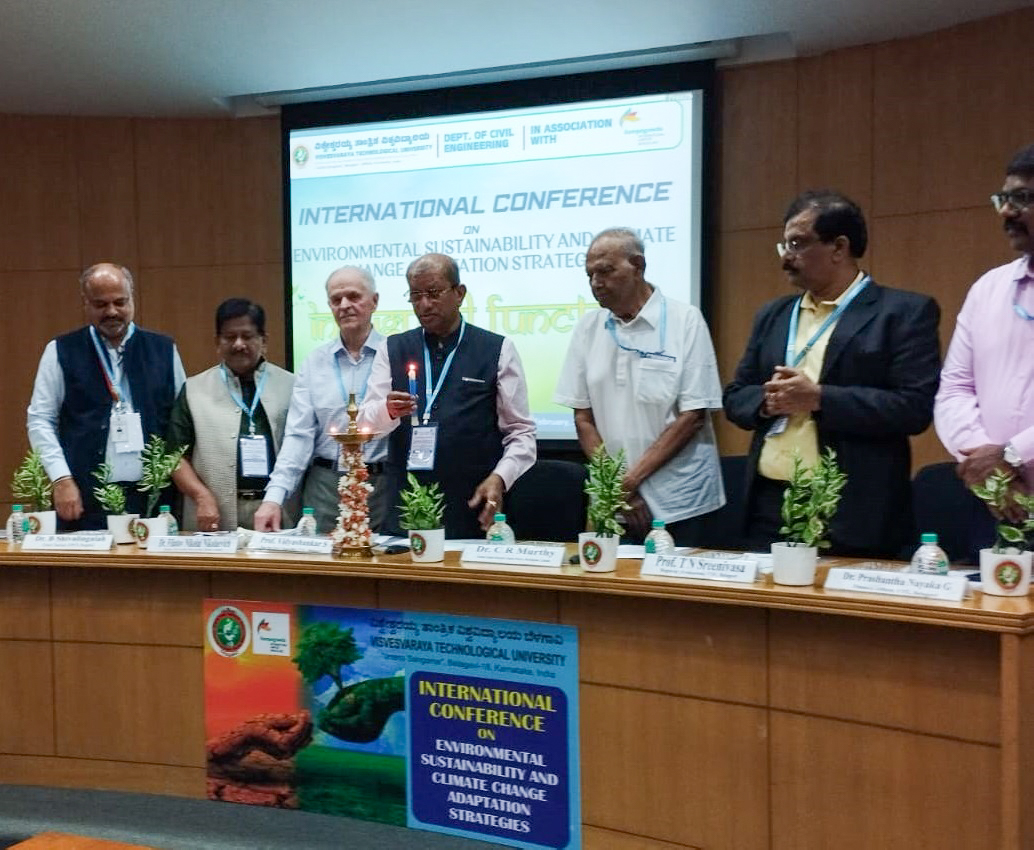
On his visit to India, Nikolai Filatov acted as a keynote invited expert at the international conference “Environmental Sustainability and Climate Change Adaptation Strategies” at Visvesvaraya Technological University (VTU) in Belagavi on February 13-14.
– India is strong in the sciences related to hydrology. This country treats basic research and practical results on water issues seriously. This is mainly because hydrological science is eesential for providing the population with drinking water, for agricultural needs - all that requires appropriate water supply, so water is a big issue in India, - noted Doctor of Geographical Sciences Nikolai Filatov.
The scientist told about the water resources of our country and the problems faced today by large lakes: Ladoga, Onego, Baikal and Caspian. In particular, global warming over the last 60 years has caused a noticeable increase in streamflow in Russia. In general, the entirety of water problems today can be grouped into two large categories - man-made ones and those related to climate change.
– In Russia, warming is quite noticeable, especially in the North. Adaptation - of water bodies and, naturally, of human life - is an acute problem. It is crucial to understand the reasons for changes in the ecosystems of lakes, reservoirs and catchments. Then we need to determine the most influential factors: whether it is human impacts - pollution, nutrient inputs - or climatic factors. According to our estimates, after 2014, the impact of anthropogenic and climatic factors on the ecosystems of lakes Ladoga and Onego is approximately equal. However, the climate cannot be changed quickly, it can only be changed in the long term over tens of years, by reducing greenhouse gas inputs. Meanwhile, it is possible to influence the anthropogenic contibution, in particular the inputs from industrial enterprises and agriculture, through legal regulation, – explained Nikolai Filatov.
The scientist emphasized that the management of water systems should be underpinned by science. Thus, in 2024 the Northern Water Problems Institute KarRC RAS has developed an information-analytical system (IAS) for assessing the state and predicting the dynamics of the lake-catchment system using Lake Onego as an example. This is the only prototype of such a system for large lakes in Russia. The system is made up of the coupled models of the lake and its catchment, which can be used to assess the current state and forecast seasonal and long-term changes in the ecosystem. The main objective is to ensure the conservation and sustainable use of resources of a water body that is strategic for the republic and the country
– At the inception stage of the cooperation, we need to discuss issues of relevance with our colleagues: hydrologists, limnologists, climatologists and others. First, it is important to hear each other, including by meeting offline at conferences and other events. Plans have been made for specialist exchanges. The next stage is to conduct joint research and prepare scientific publications, – added Nikolai Filatov, when speaking about cooperation between the two organizations.
The Memorandum of Understanding between KarRC RAS and Chanakya University is concluded for a period of five years with the possibility of automatic prolongation.
Photo provided by the Conference organizers
International
News
February 26, 2025
Karelian scientists will cooperate with colleagues from India in the study of water resources and climate change
Karelian Research Centre RAS signed a Memorandum of Understanding with Chanakya University (Bangalore, India). The envisaged cooperation topics include water resource management, climate change effects, greenhouse gas fluxes in aquatic ecosystems, conservation and restoration of water bodies, and some others.
Karelian Research Centre RAS signed a Memorandum of Understanding with Chanakya University (Bangalore, India). The envisaged cooperation topics include water resource management, climate change effects, greenhouse gas fluxes in aquatic ecosystems, conservation and restoration of water bodies, and some others.
See also:

March 30, 2026
Young CIS scientists networked on common water problems at a school and workshop organized by the KarRC RAS
The international school and workshop “Under the Pressure of Global Climate Change: a Youth Network for Water Ecosystem Research” in Petrozavodsk has come to an end. During four days, young researchers from Russia, Belarus, Kyrgyzstan, Kazakhstan, Armenia, Uzbekistan, and Tajikistan listened to lectures and mastered scientific techniques in practice, under the guidance of seasoned experts. In conclusion, the participants agreed to maintain the network and keep looking for opportunities to jointly study common environmental problems.
The international school and workshop “Under the Pressure of Global Climate Change: a Youth Network for Water Ecosystem Research” in Petrozavodsk has come to an end. During four days, young researchers from Russia, Belarus, Kyrgyzstan, Kazakhstan, Armenia, Uzbekistan, and Tajikistan listened to lectures and mastered scientific techniques in practice, under the guidance of seasoned experts. In conclusion, the participants agreed to maintain the network and keep looking for opportunities to jointly study common environmental problems.

March 27, 2026
RAS Corr. Fellow Olga Bakhmet: Arctic biodiversity conservation is impossible without science as its foundation
The International Forum "Polar Bear Universe", organized by the Ministry of Natural Resources of Russia and the Government of the Chukotka Autonomous Okrug, is taking place in St. Petersburg. At the forum’s Bio-ecological Arctic Cluster, KarRC RAS leader, RAS Corr. Fellow Olga Bakhmet spoke about the scientific foundations for conserving Arctic biodiversity and presented the expertise of Karelian scientists in this field.
The International Forum "Polar Bear Universe", organized by the Ministry of Natural Resources of Russia and the Government of the Chukotka Autonomous Okrug, is taking place in St. Petersburg. At the forum’s Bio-ecological Arctic Cluster, KarRC RAS leader, RAS Corr. Fellow Olga Bakhmet spoke about the scientific foundations for conserving Arctic biodiversity and presented the expertise of Karelian scientists in this field.

March 26, 2026
Olga Bakhmet presented KarRC’s proposals for the federal Clean Ladoga project in St. Petersburg
Experts of the Karelian Research Centre RAS have prepared proposals for the federal project Clean Ladoga. The Centre’s CEO, Olga Bakhmet, presented them at a joint meeting of the Environmental Council under the Governor of St. Petersburg and the Public Environmental Council under the Governor of the Leningrad Region. The main point of her presentation was that the integrated program for the environmental rehabilitation of Lake Ladoga must encompass also the water bodies located throughout the lake’s catchment area.
Experts of the Karelian Research Centre RAS have prepared proposals for the federal project Clean Ladoga. The Centre’s CEO, Olga Bakhmet, presented them at a joint meeting of the Environmental Council under the Governor of St. Petersburg and the Public Environmental Council under the Governor of the Leningrad Region. The main point of her presentation was that the integrated program for the environmental rehabilitation of Lake Ladoga must encompass also the water bodies located throughout the lake’s catchment area.

March 24, 2026
A youth school and workshop on aquatic ecosystem studies gathers learners and lecturers from CIS countries at the KarRC RAS
The international school and workshop "Under the Pressure of Global Climate Change: a Youth Network for Aquatic Ecosystem Research" was launched in Petrozavodsk on March 24. Over four days, young researchers from Russia, Belarus, Kyrgyzstan, Kazakhstan, Armenia, Uzbekistan, and Tajikistan will engage in theoretical and practical training under the guidance of experts from the KarRC RAS and researchers from CIS countries, India, and China.
The international school and workshop "Under the Pressure of Global Climate Change: a Youth Network for Aquatic Ecosystem Research" was launched in Petrozavodsk on March 24. Over four days, young researchers from Russia, Belarus, Kyrgyzstan, Kazakhstan, Armenia, Uzbekistan, and Tajikistan will engage in theoretical and practical training under the guidance of experts from the KarRC RAS and researchers from CIS countries, India, and China.

March 16, 2026
Karelian entomologist, Andrei Humala, discovered six new species of parasitoid wasps last year
In 2025, entomologist from Karelia, Andrei Humala, described four new parasitoid wasp species from Africa. They all belong to a genus relatively rare in that region, Eusterinx. One more finding was made in each of samples from Mexico and Russian Far East. The scientist has specialized in the study of parasitoid wasps for over 30 years, during which time he has described 3 genera and 149 species new to science.
In 2025, entomologist from Karelia, Andrei Humala, described four new parasitoid wasp species from Africa. They all belong to a genus relatively rare in that region, Eusterinx. One more finding was made in each of samples from Mexico and Russian Far East. The scientist has specialized in the study of parasitoid wasps for over 30 years, during which time he has described 3 genera and 149 species new to science.