


Dmitry Lysov is a first-year Master's student at the Faculty of Chemical, Biological, and Geographical Sciences at Vitebsk State University named after P.M. Masherov and a Specialist at the republican unitary enterprise GEOSERVICE. His research focus is on the reuse of fill soils in construction. This involves studying soil compaction and self-compaction, as well as comparing strength and deformation parameters in this process.
– Let's say there's a gully or vacant lot that's mapped in the general development layout, and in 10-20 years, they'll start building something there. Until then, they just fill it up without any control. Before starting to develop the territory, these volumes of soil have to be removed, which is itself costly, and the site has to be prepared again. But if it is initially filled following a specific procedure and with an understanding of the parameters, then this territory may easily be suitable for construction, including for 2-5-story buildings, without removing soil, - explained the master’s student.
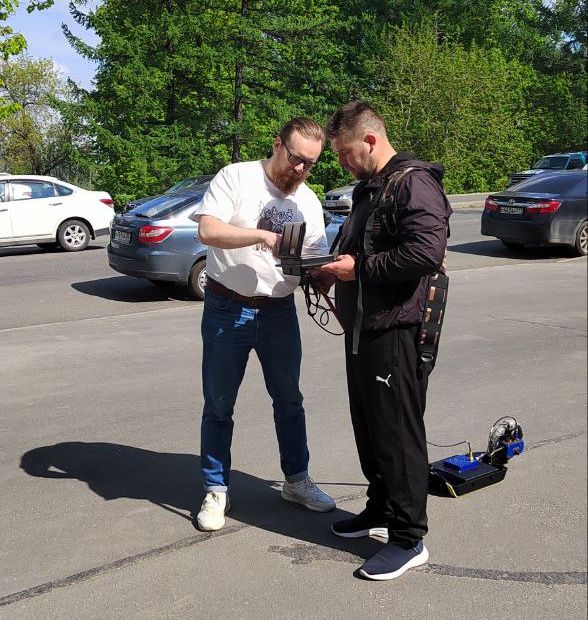
At KarRC RAS, Dmitry Lysov went through practical training in geophysics under the guidance of Pavel Ryazantsev, Leading Researcher at the Institute of Geology KarRC RAS. The scientists focused primarily on the use of ground-penetrating radar (GPR) and electrical resistivity tomography (ERT) methods using the Omega-48 instrument system and various software programs.
– GPR is used quite widely in Belarus, particularly in the inspection of building structures. But this is the first time I see 2D and 3D electrical resistivity imaging—it's an interesting and efficient technique, – noted Dmitry Lysov.
He explained that in construction, particularly in the gas and petrochemical industries, it is necessary to determine the soil's specific resistivity in order to calculate for grounding. Liquids in pipelines create a current that causes metal corrosion. To minimize the damage — to reduce the corrosion of metal structures and pipes — it is important to understand the electrical conductivity of the soil. Nowadays, it is determined by the vertical electrical sounding (VES) method, and usually three people are involved in this work.
– The 3D electrical resistivity imaging system is much better: its output is more accurate, the processing quality is higher, and the labor and time costs are three times lower. It can be handled by one person. In addition, 3D models can quite clearly image soil anomalies and defects in structures. We rarely use it, but it is worth adopting, - said Dmitry Lysov, evaluating the results of the internship.
During his trip, the guest from Vitebsk had time to see Petrozavodsk and visit some sights in the Prionezhsky and Kondopozhsky districts of the republic, including the Girvas paleovolcano and the Kivach waterfalls. In the city, Dmitry Lysov was particularly impressed by the Onego lakefront and the outdoor gym installed along the shore.
As a reminder, there is a cooperation agreement between the Karelian Research Center RAS and the Vitebsk State University. One of the cooperation formats is participation of students, doctoral students, and young scientists in events organized by the parties.
International
News
June 6, 2025
Study trip to KarRC RAS helps specialist from Vitebsk master new electrical resistivity imaging techniques, with applications in construction
Cooperation of Karelian Research Center RAS with Vitebsk State University continues. On June 5, the University's Master's student Dmitry Lysov completed his practical training course. The construction industry specialist studied the geophysical methods used by researchers at KarRC RAS.
Cooperation of Karelian Research Center RAS with Vitebsk State University continues. On June 5, the University's Master's student Dmitry Lysov completed his practical training course. The construction industry specialist studied the geophysical methods used by researchers at KarRC RAS.
See also:

March 30, 2026
Young CIS scientists networked on common water problems at a school and workshop organized by the KarRC RAS
The international school and workshop “Under the Pressure of Global Climate Change: a Youth Network for Water Ecosystem Research” in Petrozavodsk has come to an end. During four days, young researchers from Russia, Belarus, Kyrgyzstan, Kazakhstan, Armenia, Uzbekistan, and Tajikistan listened to lectures and mastered scientific techniques in practice, under the guidance of seasoned experts. In conclusion, the participants agreed to maintain the network and keep looking for opportunities to jointly study common environmental problems.
The international school and workshop “Under the Pressure of Global Climate Change: a Youth Network for Water Ecosystem Research” in Petrozavodsk has come to an end. During four days, young researchers from Russia, Belarus, Kyrgyzstan, Kazakhstan, Armenia, Uzbekistan, and Tajikistan listened to lectures and mastered scientific techniques in practice, under the guidance of seasoned experts. In conclusion, the participants agreed to maintain the network and keep looking for opportunities to jointly study common environmental problems.

March 27, 2026
RAS Corr. Fellow Olga Bakhmet: Arctic biodiversity conservation is impossible without science as its foundation
The International Forum "Polar Bear Universe", organized by the Ministry of Natural Resources of Russia and the Government of the Chukotka Autonomous Okrug, is taking place in St. Petersburg. At the forum’s Bio-ecological Arctic Cluster, KarRC RAS leader, RAS Corr. Fellow Olga Bakhmet spoke about the scientific foundations for conserving Arctic biodiversity and presented the expertise of Karelian scientists in this field.
The International Forum "Polar Bear Universe", organized by the Ministry of Natural Resources of Russia and the Government of the Chukotka Autonomous Okrug, is taking place in St. Petersburg. At the forum’s Bio-ecological Arctic Cluster, KarRC RAS leader, RAS Corr. Fellow Olga Bakhmet spoke about the scientific foundations for conserving Arctic biodiversity and presented the expertise of Karelian scientists in this field.

March 26, 2026
Olga Bakhmet presented KarRC’s proposals for the federal Clean Ladoga project in St. Petersburg
Experts of the Karelian Research Centre RAS have prepared proposals for the federal project Clean Ladoga. The Centre’s CEO, Olga Bakhmet, presented them at a joint meeting of the Environmental Council under the Governor of St. Petersburg and the Public Environmental Council under the Governor of the Leningrad Region. The main point of her presentation was that the integrated program for the environmental rehabilitation of Lake Ladoga must encompass also the water bodies located throughout the lake’s catchment area.
Experts of the Karelian Research Centre RAS have prepared proposals for the federal project Clean Ladoga. The Centre’s CEO, Olga Bakhmet, presented them at a joint meeting of the Environmental Council under the Governor of St. Petersburg and the Public Environmental Council under the Governor of the Leningrad Region. The main point of her presentation was that the integrated program for the environmental rehabilitation of Lake Ladoga must encompass also the water bodies located throughout the lake’s catchment area.

March 24, 2026
A youth school and workshop on aquatic ecosystem studies gathers learners and lecturers from CIS countries at the KarRC RAS
The international school and workshop "Under the Pressure of Global Climate Change: a Youth Network for Aquatic Ecosystem Research" was launched in Petrozavodsk on March 24. Over four days, young researchers from Russia, Belarus, Kyrgyzstan, Kazakhstan, Armenia, Uzbekistan, and Tajikistan will engage in theoretical and practical training under the guidance of experts from the KarRC RAS and researchers from CIS countries, India, and China.
The international school and workshop "Under the Pressure of Global Climate Change: a Youth Network for Aquatic Ecosystem Research" was launched in Petrozavodsk on March 24. Over four days, young researchers from Russia, Belarus, Kyrgyzstan, Kazakhstan, Armenia, Uzbekistan, and Tajikistan will engage in theoretical and practical training under the guidance of experts from the KarRC RAS and researchers from CIS countries, India, and China.

March 16, 2026
Karelian entomologist, Andrei Humala, discovered six new species of parasitoid wasps last year
In 2025, entomologist from Karelia, Andrei Humala, described four new parasitoid wasp species from Africa. They all belong to a genus relatively rare in that region, Eusterinx. One more finding was made in each of samples from Mexico and Russian Far East. The scientist has specialized in the study of parasitoid wasps for over 30 years, during which time he has described 3 genera and 149 species new to science.
In 2025, entomologist from Karelia, Andrei Humala, described four new parasitoid wasp species from Africa. They all belong to a genus relatively rare in that region, Eusterinx. One more finding was made in each of samples from Mexico and Russian Far East. The scientist has specialized in the study of parasitoid wasps for over 30 years, during which time he has described 3 genera and 149 species new to science.